CnDeleteDialog
Two-phase single-item delete confirmation dialog. Shows a warning, waits for API response, then shows success or error.
Try it
Loading CnDeleteDialog playground…
Wraps: NcDialog, NcButton, NcNoteCard, NcLoadingIcon
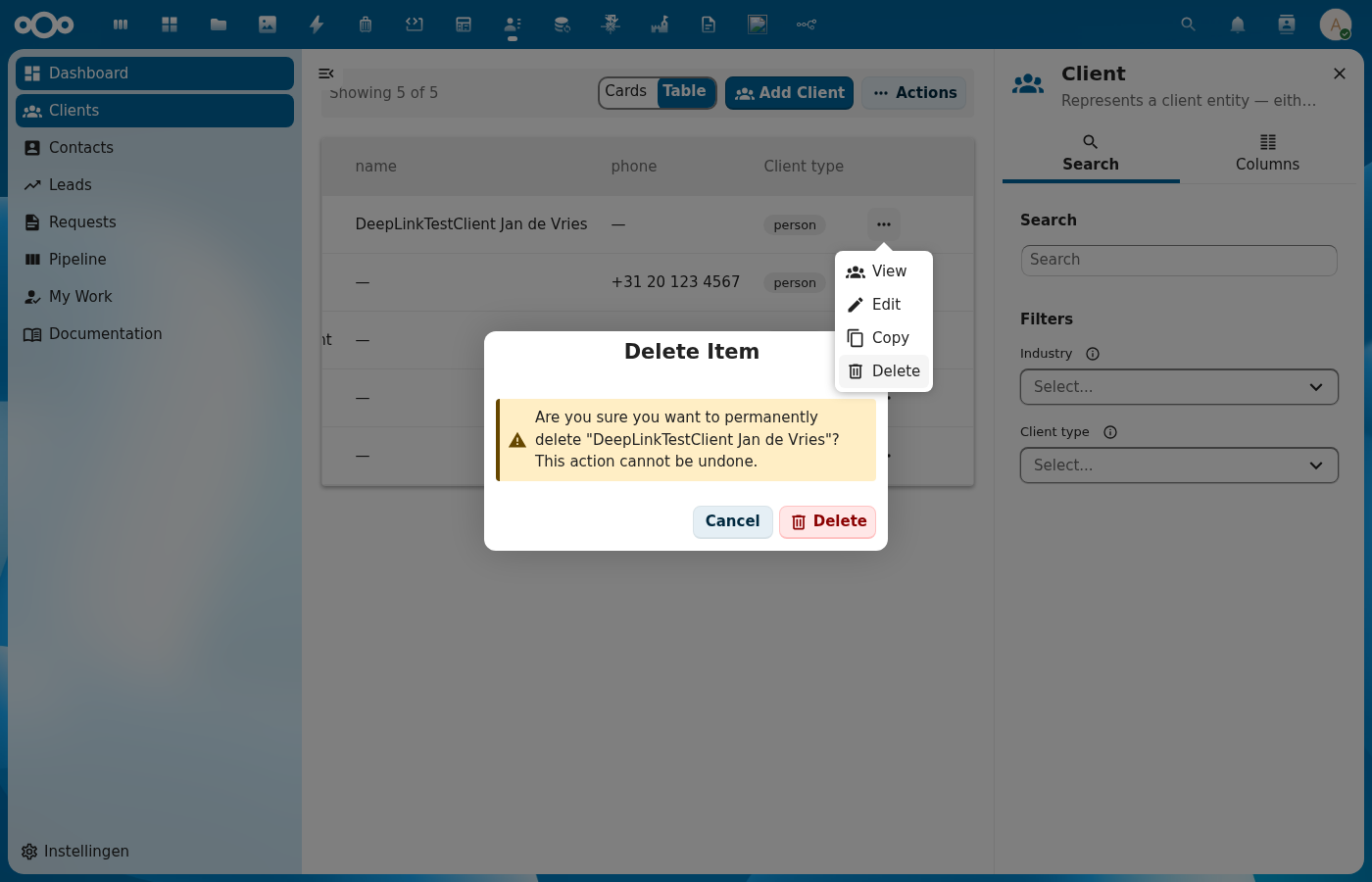
Live demo
<template>
  <div>
    <button @click="open = true" style="padding: 6px 16px; border-radius: 4px; background: var(--color-primary-element); color: white; border: none; cursor: pointer;">Delete item</button>
    <CnDeleteDialog
      v-if="open"
      ref="dlg"
      :item="{ id: 1, title: 'Annual Report 2024' }"
      @confirm="onConfirm"
      @close="open = false" />
  </div>
</template>
<script>
export default {
  data() { return { open: false } },
  methods: {
    async onConfirm(id) {
      await new Promise(r => setTimeout(r, 800))
      this.$refs.dlg.setResult({ success: true })
    },
  },
}
</script>
Props
| Prop | Type | Default | Description |
|---|---|---|---|
item | Object | (required) | Item to delete (must have id) |
nameField | String | 'title' | Field used as display name |
nameFormatter | Function | null | Optional function (item) => string to format the display name. Overrides nameField when provided. |
dialogTitle | String | 'Delete Item' | |
warningText | String | 'Are you sure...' | Supports \{name\} placeholder |
successText | String | 'Item successfully deleted.' | |
cancelLabel | String | Cancel button label | |
closeLabel | String | Close button label | |
confirmLabel | String | Confirm button label |
Events
| Event | Payload | Description |
|---|---|---|
confirm | id | Delete confirmed by user |
close | — | Dialog closed |
Public Methods
| Method | Description |
|---|---|
setResult(\{ success?, error? \}) | Set operation result after API call |
Custom Name Formatting
When items don't have a simple name field, use nameFormatter to build a display name from any item properties:
<CnDeleteDialog
  :item="auditTrail"
  :name-formatter="(item) => t('myapp', 'Audit Trail #{id}', { id: item.id })"
  @confirm="onDeleteConfirm"
  @close="deleteItem = null" />
Two-Phase Pattern
<template>
  <CnDeleteDialog
    v-if="deleteItem"
    ref="deleteDialog"
    :item="deleteItem"
    @confirm="onDeleteConfirm"
    @close="deleteItem = null" />
</template>

<script>
export default {
  methods: {
    async onDeleteConfirm(id) {
      try {
        await api.delete(id)
        this.$refs.deleteDialog.setResult({ success: true })
      } catch (error) {
        this.$refs.deleteDialog.setResult({ error: error.message })
      }
    },
  },
}
</script>
Reference (auto-generated)
The tables below are generated from the SFC source via vue-docgen-cli. They reflect what's actually in CnDeleteDialog.vue and update automatically whenever the component changes.
Props
| Name | Type | Required | Default | Description |
|---|---|---|---|---|
item | object | ✓ | — | The item to delete. Must have an id property. |
nameField | string | 'title' | Property name used for display (e.g., 'title', 'name') | |
nameFormatter | func | null | Optional function to format the item name. Receives the item, returns a string. Overrides nameField when provided. | |
dialogTitle | string | () => t('nextcloud-vue', 'Delete item') | Dialog title | |
warningText | string | () => t('nextcloud-vue', 'Are you sure you want to permanently delete "\{name\}"? This action cannot be undone.') | Warning text. Use {name} as placeholder for the item name. | |
successText | string | () => t('nextcloud-vue', 'Item successfully deleted.') | Success message | |
cancelLabel | string | () => t('nextcloud-vue', 'Cancel') | Label for the cancel button (visible before the delete runs). | |
closeLabel | string | () => t('nextcloud-vue', 'Close') | Label for the close button (visible after delete completes). | |
confirmLabel | string | () => t('nextcloud-vue', 'Delete') | Label for the primary confirm button that triggers the delete. |
Events
| Name | Payload | Description |
|---|---|---|
close | — | |
confirm | — |
Methods
| Name | Description |
|---|---|
setResult | Set the result of the delete operation. Call this from the parent after the API call completes. |